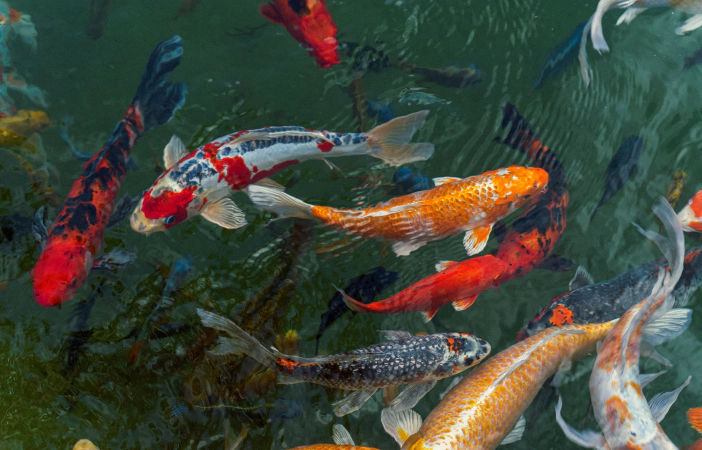
The rule of thumb for how many gallons and pond dimensions you need for koi is:
- 1 koi needs 250-500 gallons.
- Koi need at least 3 feet of depth to avoid predators.
So, if you want to keep koi, your pond needs to be at least 3 feet deep and have at least 250-500 gallons of water for each koi you want to keep.
You can get away with 250 gallons per koi if you have a good filter and don’t overfeed them, but if you want to be safe, then it’s best to go for 500 gallons per koi.
Be aware that this rule of thumb is for keeping koi to a good standard. The more space and water volume you can give them, the better. A bigger pond is less maintenance too, because there’s more water to dilute the fish waste.
Pond Size for Koi
The minimum pond size for koi is worked out by:
(Number of koi) * (Gallons per koi)
So for example, if you wanted to keep four koi, then the minimum pond size you’d need would be:
4 * 500 = 2000 gallons
You can use the same formula to work out how many koi you can keep in your existing pond. Just divide your pond’s volume by the number of gallons one koi needs.
Pond Depth for Koi
The depth of your pond is actually the most important dimension when it comes to koi keeping. You see, most predators that eat koi cannot dive.
For example, herons can’t dive. They just stand in the water and spear the fish with their beaks. That’s why they’re so afraid of humans. They can’t get away in time.
If your pond is shallow, you’ll need a heron fence to stop them from eating your fish. However, a heron fence is a bit unsightly and can be expensive, so it’s better to just have a deeper pond.
The depth of your pond should be measured from the water surface to the bottom of the pond, not from the top of the pond liner to the bottom of the pond.
The reason why is because when you fill your pond with water, it’s the water level that you’re going to be measuring from, not the top of the pond liner.
You see, you want to give your koi enough space to swim about freely without having to worry about being eaten by a predator.
Now, the space that your koi need is three feet. That’s the minimum.
The reason why three feet is the minimum depth you should have is because that’s about the length of a heron’s neck. If your pond is any deeper, then herons will have no chance of catching your koi.
Of course, if you have blue herons in your area, then you’ll want to go for four feet, because that’s how long their necks are.
If you have raccoons in your area, then you’ll want to go for even deeper than that, because they can actually swim underwater.
It’s up to you how much of a margin of safety you want to have.
As for the maximum depth, the deeper your pond, the better. The more water you have, the more stable the temperature of your pond will be.
A stable temperature is important because koi are cold blooded, so their metabolism is dependent upon the temperature of their surroundings. The warmer they are, the faster their metabolism will be.
A fast metabolism is good for koi, because that means they can grow faster and live longer. The ultimate aim of any koi keeper is to have koi that grow to be prize-winning size.
For koi to grow to be prize-winning size, you’ll need a pond that’s at least six feet deep. A six foot deep pond is the minimum depth that koi can swim in without feeling cramped.
If you want to have a pond that’s six feet deep, then you’ll need to have a pond that’s at least six feet wide.
You might be thinking, “How come?”
Well, the balance of the pond water’s ecosystem is what keeps koi healthy. In nature, it’s the balance of the ecosystem in the river that keeps koi healthy, so you’ve got to replicate that as best you can.
You see, in a river, there’s a constant flow of water that brings in fresh water and takes away the waste. This helps to keep the balance of the ecosystem in the river stable.
However, in a pond, if the water isn’t circulated enough, then the balance of the ecosystem will become unstable. This will cause your koi to be more prone to disease.
The general rule of thumb when it comes to the circulation of the water in your pond, is to cycle all the water in your pond once every two hours.
You can calculate how powerful your pump needs to be by finding the volume of your pond and dividing it by 60 (to convert minutes to hours), then dividing it by 2.
The formula for that is:
(Pond Volume in Gallons) / 60 / 2 = (Flow Rate of Pump Required in Gallons Per Minute)
So let’s say you have a 2000 gallon pond, then you’d need a:
2000 / 60 / 2 = 16.67 GPM
Now, you might be wondering why you can’t just get a pump that has a flow rate of 16.67 GPM.
Well, it’s because as the pump pushes the water through the pipes, it loses some of its power. This means, that if you get a pump that has a flow rate of exactly 16.67 GPM, then the water that comes out of the return water pipe will be slower than you want.
To avoid this, you’ll need a pump that has a higher flow rate than the minimum required. It’s best to get one that has 20% more flow rate than the minimum required, so that you can be sure that it’ll be powerful enough.
The formula for that is:
(Flow Rate of Pump Required in Gallons Per Minute) * 1.2 = (Flow Rate of Pump You Should Get in Gallons Per Minute)
So, to continue the example, if you have a 2000 gallon pond, then you’d need a:
16.67 * 1.2 = 20 GPM
Now, the flow rate of a pump is measured in gallons per minute (GPM), so to convert that into gallons per hour (GPH), you just multiply the flow rate by 60.
The formula for that is:
(Flow Rate of Pump You Should Get in Gallons Per Minute) * 60 = (Flow Rate of Pump You Should Get in Gallons Per Hour)
So, to continue the example, if you have a 2000 gallon pond, then you’d need a:
20 * 60 = 1200 GPH
Now, if you have a six foot deep pond, then to cycle all the water in your pond once every two hours or less, you’d need a pump with a flow rate that’s at least 1200 GPH.
That’s why you need a pond that’s at least six feet deep for koi that’ll grow to be prize-winning size.