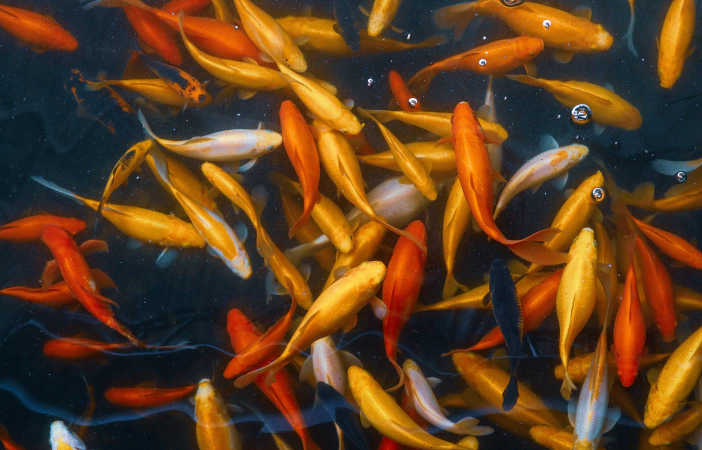
The number one mistake that people make when it comes to keeping koi ponds is that they keep koi in them.
They’re not the best fish to keep.
Yes, they’re hardy, and yes, they can survive winter. This is why people mistakenly think that it’s possible to keep koi in a pond. It’s not the koi that die in winter – it’s their filtration system.
If you have a pond that’s large enough to be able to support a koi, then you’re going to have a pond that’s large enough to have a proper filtration system too.
The reason that this is a problem is that koi have a habit of digging up your pond’s filtration system. They’ll dig up all the sand and gravel you’ve put down until they reach the bare dirt.
So, to get around that, you need some kind of pond filtration system that koi can’t dig up.
Canister filters are the best option, since they’re out of reach of koi, but other submersible filters will do too.
The only problem, however, is that it’s going to be impossible to get one that’s going to be able to handle the sheer volume of waste that koi produce.
You see, koi are big fish, and big fish produce big waste.
Even if you managed to get a submersible filter that was big enough, the sheer amount of waste that they would produce would clog it up incredibly quickly.
It’s just not worth it.
All you’re going to end up with is a fish that you can’t keep in a pond because it’s too small, and a pond that you can’t keep the fish in anyway because it’s too small to get a filter in there that’s big enough.
So What Fish Can You Keep in a Pond?
There are plenty of fish that can survive winter just as well as your koi can. They’re called “pond fish.”
Now, pond fish are much more adapted for the outdoor life than koi are, so they’re much better at surviving winter.
You see, koi are actually a type of carp, and carp don’t do very well when it comes to surviving winter. They’re not as cold-resistant as pond fish are.
This is why you’ll often see koi ponds that are heated in winter. It’s the best way to be able to keep koi, but it’s not the most practical.
Now, if you want to be able to keep koi in winter, I’d say that the best way to do it is to get a big pond, and only keep a few of them.
You’ll need a really big pond, especially if you want to be able to keep them without a heater.
This is because, as I said earlier, the problem with keeping koi in a pond is that their waste will clog up your filter.
So, if you want to be able to keep them, you’re going to need a pond that’s big enough that you can have a filter that’s big enough.
The general rule of thumb is that you need a pond that’s at least 1,000 gallons if you want to be able to keep koi in winter. If you have a pond that’s bigger than that, then you should be fine to keep some koi in it, provided that you don’t overstock it.
If you want to be able to keep a lot of koi, then your pond is going to have to be even bigger.
You see, koi are really big fish. They grow up to 36 inches long, and they can live for 50 years. They’re not the kind of fish that you can keep in anything smaller than a 1,000 gallon pond for very long.
Don’t be fooled by the size of young koi. Yes, they look tiny when you first get them, but they grow really quickly. If you’re not prepared to have a 36 inch fish in your pond, then you’re not prepared to keep koi in a pond.
Anyway, let’s move on from koi and talk about some actual pond fish that you can keep in your pond.
The Best Pond Fish to Keep
There are really only three main types of pond fish that you can keep, and they are:
- Goldfish
- Shubunkins
- Comets
Now, goldfish are the smallest of these three types, and shubunkins are the largest.
You can keep any combination of these three types in your pond, provided that it’s big enough, and that you have a proper pond filter that’s capable of handling the waste.
The only thing that you have to keep in mind is that shubunkins and comets get a lot bigger than your normal goldfish do. They grow up to 18 inches long, whereas goldfish only grow up to 10 inches long.
Also, shubunkins and comets are more slender than goldfish. Goldfish are a lot rounder.
Basically, if you want a pond fish that looks like the type of goldfish that you’d win at the fair, then you’re best off getting goldfish. Just be aware that they’re going to get a lot bigger than what you’re used to seeing them as.
If you want a pond fish that looks more like the goldfish you’re used to seeing, then you’re best off getting shubunkins or comets.
If you want a pond fish that looks more like the type of goldfish that you’d win at the fair, then you’re best off getting wakin goldfish. They look like shubunkins, but with a double tail.
They’re all great fish, and they all look amazing in a pond.
How Many Pond Fish Can You Keep in Your Pond?
The rule of thumb is that you can have one inch of pond fish per square foot of surface area.
Yes, surface area, not volume. This is because it’s the surface area that determines how much oxygen can enter your pond. The more surface area that you have, the more oxygen will be able to enter your pond, and the more fish you’ll be able to keep.
Surface area isn’t the same as width though. It’s the total area of the surface of the pond. To find it, you just have to multiply the length of the pond by the width of the pond.
The other thing that you have to keep in mind is that this rule only applies to pond fish. If you’re keeping koi, then you need to have at least double the surface area. That’s because, as I said earlier, they produce a lot more waste than pond fish do.
It’s also worth noting that this rule is based upon the idea that your pond is getting plenty of oxygen. If you want to be on the safe side, then it’s a good idea to get an air pump so that your pond can get even more oxygen. This is especially important if you have a lot of fish, or if you’re keeping koi.
What About Winter?
The reason that I’m talking about how many fish you can keep based upon the surface area of your pond is because it’s the amount of oxygen that your pond gets that’s the limiting factor when it comes to how many fish you can keep.
I know this is a pretty obvious point to make, but it’s a point that’s worth repeating.
The reason that it’s worth repeating is because it’s important to realize that the surface area of your pond is always the same regardless of whether it’s summer or winter.
This means that the amount of fish that you can keep in your pond during winter is exactly the same as the amount of fish that you can keep in your pond during summer.
In case you’re wondering, yes, pond fish are fine in winter. They’re actually a lot more cold-resistant than you might think.
Just make sure that your pond is at least 18 inches deep, and you’ll be fine.
Fish are actually pretty good at surviving winter. They go into a sort of hibernation mode where they just sit at the bottom of the pond, and they don’t really move around that much.
People think that they’re dead when they see them like this, but they’re not.
If you want to be sure that they’re still alive, then you can tap the side of the pond. If they’re still alive, then they’ll quickly dart off to the other side of the pond. If they’re dead, then they’ll just float there.
It’s worth noting that this hibernation mode that pond fish go into is totally normal, and not something to be worried about. They’re not suffering, they’re just conserving their energy until the water warms up again.
So, to summarize, the amount of fish that you can keep in your pond is always going to be limited by the surface area of your pond, regardless of whether you’re keeping pond fish or koi.
Also, pond fish are fine in winter. They’re cold-resistant, and they go into a hibernation mode where they just sit at the bottom of the pond.