Well, it’s a good thing that you’ve come to me about this topic. I can give you a bit of a head start.
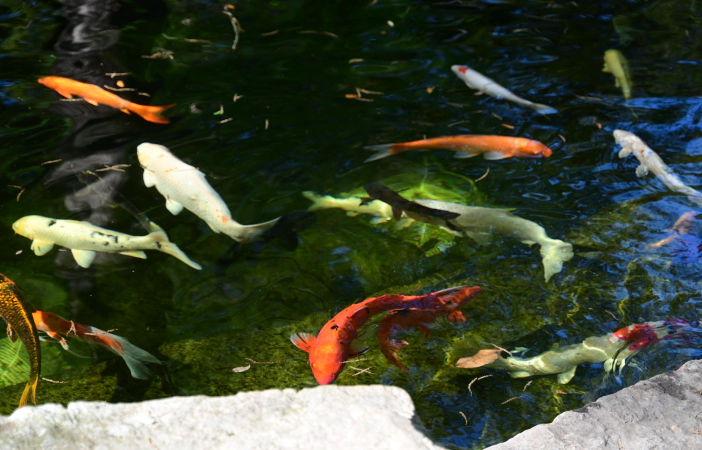
There are only two cold water pond fish that you can safely keep in a pond during the winter. I’ll list them here:
- Koi
- Goldfish
And yes, they can live in a pond over winter without a heater or anything.
If you’re in a cold climate, then you might have to do a few things to stop your pond from freezing over. It’s not the fish dying of the cold that’s the problem, it’s the fact that they will quickly run out of oxygen if there’s no way for them to get air.
The main way that fish get air is by coming to the surface of the water and getting some from the air. That’s why you need to keep the surface of your pond free from ice.
The way that you can do that is to get a small pond heater, or a pond de-icer. They’re basically the same thing, and they work by warming up a small area of the water, so that it doesn’t freeze over. They’re not very expensive, and they cost a lot less to run than an actual pond heater.
You only need to get one if you live in an area where your pond is likely to freeze over. If you do, then it’s definitely worth getting one.
If you’re in a climate where your pond is unlikely to freeze over, then all you need to know is that you’re good to keep koi or goldfish.
Back to the topic of this article.
Cold Water Pond Algae Eating Fish
If you haven’t guessed it by now, the thing that I’m about to tell you is the single defining factor when it comes to choosing fish to eat the algae in your pond.
Cold water pond algae eating fish are the only algae eating fish that you can keep in a pond that you don’t want to run a heater for.
That’s because all other algae eating fish need the water temperature to be at least in the 70’s to 80’s range, and even then, they still need to be acclimated to the water.
So, what are these cold water pond algae eating fish that you can keep in a pond without a heater?
Well, I’ve got some good news and some bad news for you.
The good news is that one of them is hands down the most effective algae eating fish there is. It’s great for big ponds, and it’s great for small ponds. It’s great for man made ponds, and it’s great for natural ponds. It’s just plain great.
The bad news is that the other one isn’t actually a fish at all. It’s a type of snail. If you don’t like snails, then you might be a bit disappointed, but I can assure you that the fish is so good that it will more than make up for it. You won’t need any more than one snail to go with it.
Anyway, enough teasing. Here’s the list.
Cold Water Pond Algae Eating Fish:
- Koi
- Goldfish
And here’s the one snail.
Cold Water Pond Algae Eating Snail:
- Trapdoor Snails
Yes, that’s right, you only need one.
Cold Water Pond Algae Eating Snails
You only need one cold water pond algae eating snail because they reproduce very slowly. They’re called “live bearing” snails, and they only have a few babies per year. They’re not like those other nuisance snails that can reproduce asexually and lay hundreds of eggs in one go.
Actually, there’s something I have to make clear here. There are more species of snail that can eat algae, but they don’t do it as well as trapdoor snails. They’re not cold water pond algae eating snails, because they need the water to be in the 70’s to 80’s range to be able to live.
You need to make sure that you’re getting trapdoor snails and not the other kind, because trapdoor snails really are the only kind of snail that you can get that will live in your pond all year round. All other snails will die off in the winter, and you’ll have to start again next year.
I say that you only need one trapdoor snail because they’re about the same size as koi or goldfish, and they can eat about the same amount of algae as one koi or goldfish can.
Since koi and goldfish are so much faster at eating algae than any other fish, a single one will be more than able to keep up with the algae production of your pond.
If you have more than one koi or goldfish, then you might want to get a couple more trapdoor snails. The general rule is that you get one snail per koi or goldfish that you have. This is just a rough rule of thumb, because you can’t really go wrong with having too many.
Remember, the snails reproduce very slowly, so you’ll still have the same amount next year if you have too many this year. You’ll be fine.